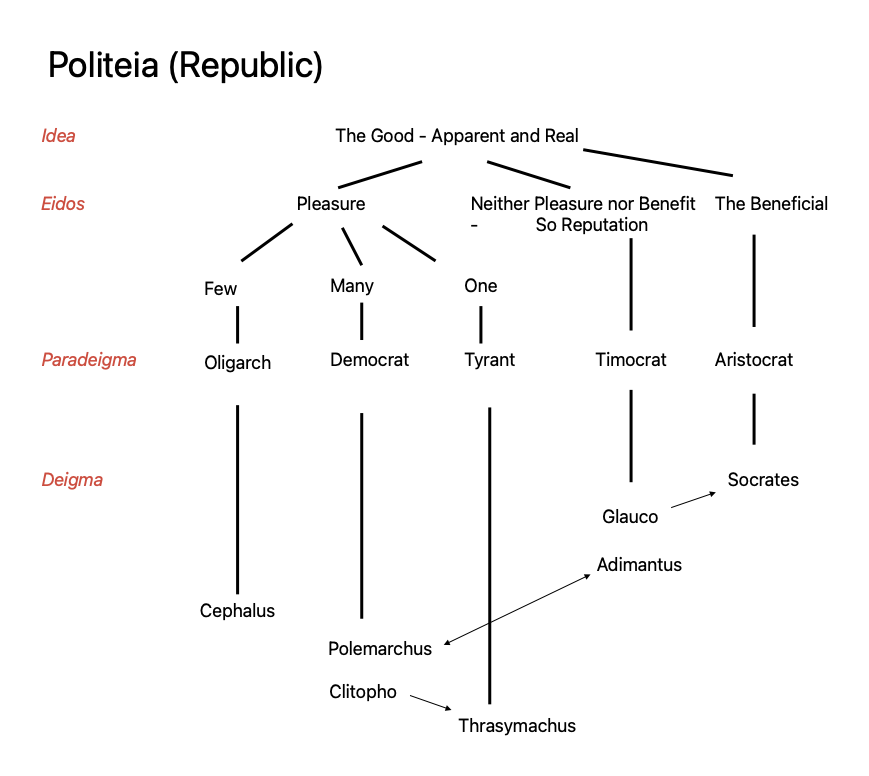
Brief Explanation of the Diagram
Book Excerpt – Chapter 6 “The Digression”
From Plato’s Republic as a Philosophical Drama on Doing Well
Bloomsbury (originally Lexington Books, 2014)
The full book is available from Bloomsbury
© Ivor Ludlam 2014.
Reproduced by permission of Bloomsbury Publishing Plc under its self-archiving policy.
This chapter examines Books V–VII of Plato’s Republic — the Three Waves, the Sun, the Divided Line, and the Cave — within the dramatic and structural argument of the dialogue. It argues that the so-called philosophical “kernel” of the Republic cannot be separated from Socrates’ pedagogical strategy toward his timocratic interlocutors.
Contents (as published)
1 Introduction
2 The Thrasymachus Problem
3 A Philosophical Drama
4 The Characters
5 Socrates and the Logos
6 The Digression
7 A Model Dialogue
8 Doing Well
9 A Dialogue on Apparently Doing Well
Works Cited
Index
Article — “Thrasymachus in Plato’s Politeia I”
“Thrasymachus in Plato’s Politeia I”, Maynooth Philosophical Papers 6 (2011), 18-44.
A careful reading of the debate between Thrasymachus and Socrates in the second half of Book I of the Republic reveals a discussion far removed from philosophical inquiry. It is thoroughly eristic. The article was written to raise questions about this exchange that are usually passed over in the secondary literature. A later version of the argument became Chapter 2 of Plato’s Republic as a Philosophical Drama on Doing Well (Bloomsbury, 2014).
 The Plato Paradigm